
IQlab / Everest hardware
Universal peripheral controller
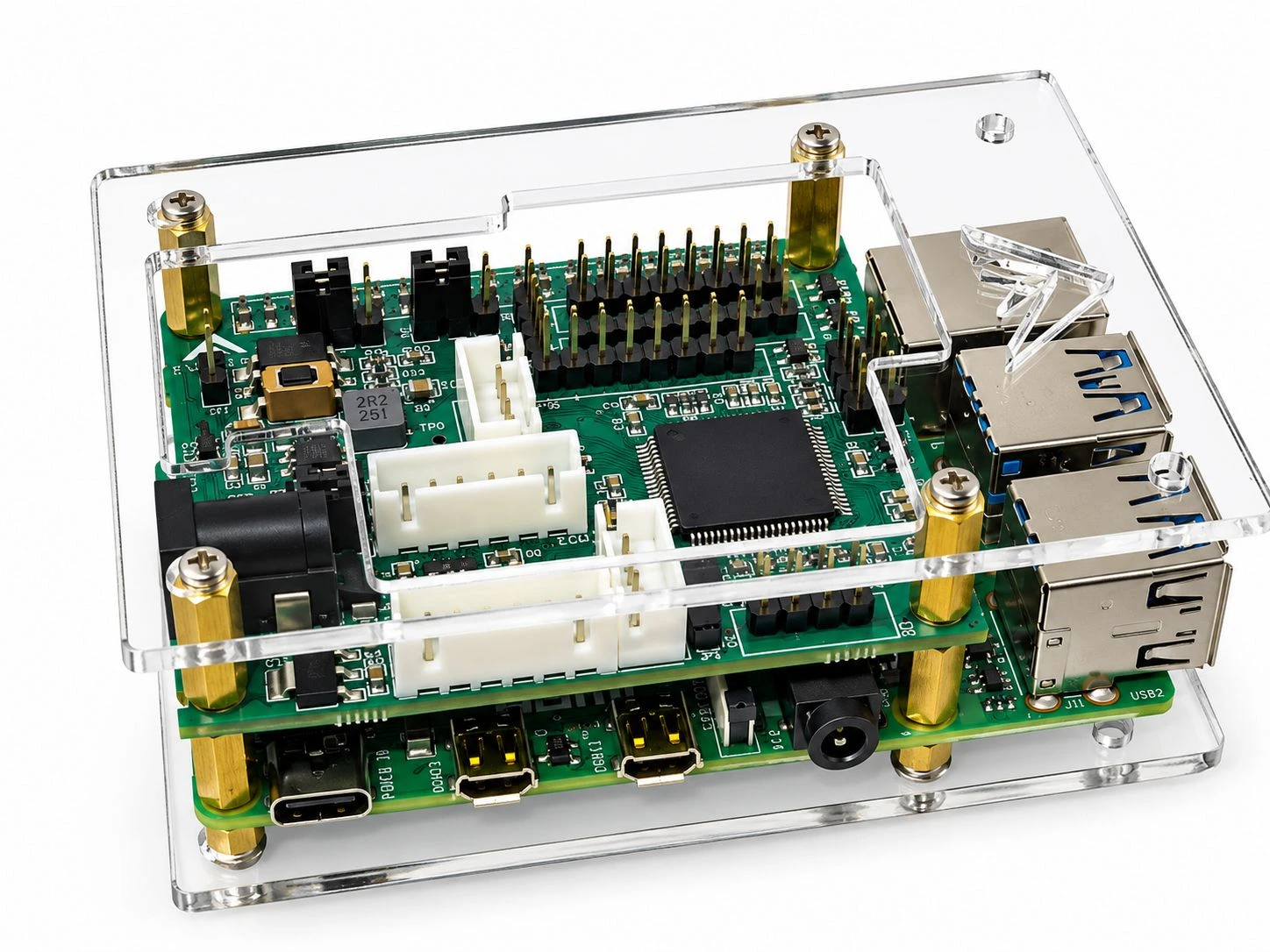
A ready hardware platform for software teams. Connect peripherals to a single-board computer and build standalone automation without a conventional PC.
Discuss a project ↗
24/7
Proven through years of operation
Everest controllers and readers have been proven through several years of round-the-clock operation in deployed systems.
Interfaces and hardware
Interfaces
UART, I²C, SPI, GPIO
Microcontroller
STM32F103 or ATmega, depending on configuration
Power
Dedicated power for the controller, peripherals and single-board computer
Controls and indication
4 LEDs, 4 DIP switches/jumpers, a button and an optocoupler
Firmware updates
Through the connected single-board computer
Development
Arduino compatibility; environment and firmware matched to the configuration
Supported single-board computers
- Raspberry Pi 3 / 4 / 5
- Orange Pi PC / PC2 / 3B / One
- Repka Pi
- ROCK Pi 4A / 4B
- ASUS Tinker Board 1 / 2
We match the configuration, connections and power budget to the selected computer and peripherals.
A standalone terminal without a PC
A Raspberry Pi with a touchscreen runs the user interface and application. The controller connects it to peripherals such as banknote acceptors, banknote dispensers, receipt printers and other devices. This assembly provides a foundation for self-service kiosks, dispensing systems and purpose-built automation.
For each cash peripheral model we verify the electrical interface, protocol, power and commands. The touchscreen connects to the single-board computer and is selected for its capabilities.
Sharing work between Linux and the microcontroller
The computer runs the interface, network services and business logic. The microcontroller handles connected peripherals and reports their states. Software teams can focus on the application while using a ready hardware foundation instead of designing a board from scratch.
Project-specific peripheral integration
UART supports serial communication, I²C and SPI connect compatible modules, and GPIO handles discrete signals. Matching interface names do not guarantee matching device protocols: voltage levels, pin assignments, commands and power must be agreed. Each banknote acceptor, dispenser and receipt printer is checked by model and operation acknowledgement.
Assembly and maintenance
A terminal project can include a touchscreen, networking and a control application. Peripheral consumption is assessed alongside computer load. Updating through the computer supports assembly maintenance; update and recovery procedures are matched to the STM32F103 or ATmega version.